
The European Product Act: what the leaked draft means for your product compliance data
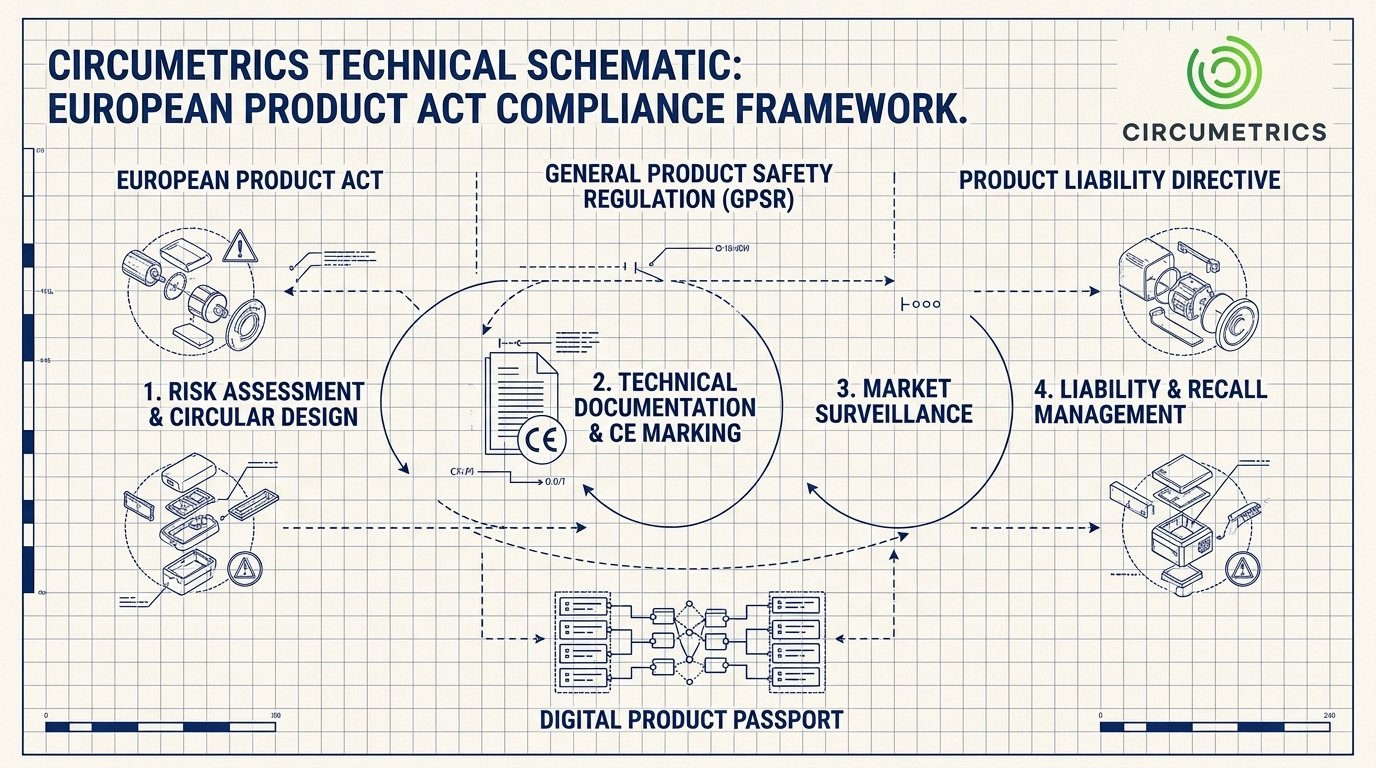
The European Product Act (EPA) would make product data a condition of entry to the EU market. A draft leaked last month, and the European Commission is expected to publish its formal proposal on 6 October 2026. For operations and supply chain directors, the change lands in the shipment flow. Registry entries, customs checks and marketplace listings would all decreate me a technical line drawing image depicting the Environmental Product Act.pend on the product and packaging data you already hold for PPWR and EPR.
This article is based on the leaked draft. The text may change before and after 6 October, and we will update this page when the official proposal is published.
Key Takeaways
- The European Product Act is a proposed EU regulation that would replace the 2008 New Legislative Framework and the Market Surveillance Regulation for most non-food products.
- Every in-scope product would need a digital product passport or a “product responsibility record” registered in a new EU registry before it goes on sale.
- Customs would check that data automatically before releasing goods. Incorrect passport data is on the draft list of infringements, with penalties of 1% to 6% of global annual turnover.
- EPR laws for packaging, batteries, electronics and textiles stay in place. They rely on the same product and packaging data the EPA would check.
- One product and packaging data model, built now for PPWR, can serve EPR reporting and the EPA later.
A five-figure saving hidden in packaging data
A medical products company asked us to review its packaging compliance across the UK and the EU. We ran a gap analysis and a regulatory review, then built a compliance roadmap with their team.
The finding that surprised the client was financial. Some of its packaging sat in a higher EPR fee band than the data could justify. The evidence for a better rating existed, spread across supplier specifications, regulatory files and procurement records. Nobody had put it together. Once the data was in one place, the roadmap set out a five-figure saving the client is now working towards.
That result follows from how eco-modulated fees work. Under UK packaging EPR, PackUK’s Recyclability Assessment Methodology (RAM) rates household packaging red, amber or green. Packaging without evidence for amber or green must be reported as red. Red-rated packaging pays 1.2 times the amber disposal fee in 2026/27, rising to 1.6 times in 2027/28 and 2 times in 2028/29. The cost of missing evidence goes up every year.
The EU is moving the same way. The Packaging and Packaging Waste Regulation (PPWR) requires EPR fees in every Member State to vary by recyclability grade once the grading rules are adopted.
Medical packaging adds another layer. The PPWR gives contact-sensitive primary packaging for medical devices some relief on recyclability and recycled content. Outer cartons and transport packaging get none of that relief, and EPR, conformity assessment and substance limits apply to all of it. Knowing which component sits in which category is itself a data question.
The European Product Act would take the same principle further, from fees to market access.
What is the European Product Act?
The European Product Act is a proposed EU regulation that would set common rules for placing manufactured products on the EU market. It would replace the 2008 New Legislative Framework, which set the general structure for CE-marked products, and the Market Surveillance Regulation.
It is part of a wider “European Product Package” and is designed to work with the General Product Safety Regulation (GPSR), the revised Union Customs Code and the Digital Services Act.
Because it is drafted as a regulation, it would apply directly in all 27 Member States without national transposition. Scope is wide: everything currently covered by the New Legislative Framework and the GPSR. Food, feed, medicinal products, living plants and animals, and products of human origin are excluded. After the Commission publishes its proposal, the European Parliament and the Council negotiate the text, and it may change materially.
What the draft changes for operations and supply chain teams
The draft moves compliance out of the technical file and into the shipment flow. These are the changes most likely to land on an operations or supply chain director’s desk:
- 1. Pre-market registration. Each product’s digital product passport or product responsibility record must be registered in a new EPA Registry before the product is placed on the market. Made-to-order products need a pre-manufacture passport.
- 2. Digital by default. The draft extends the digital product passport (DPP) regime, adds the product responsibility record where no DPP is required, and moves CE marking to digital.
- 3. Customs checks. Customs would verify the passport or record automatically before goods are released into free circulation. If the data fails the check, the goods do not pass.
- 4. An accountable EU operator. A non-EU manufacturer must have an importer or an authorised representative in the EU. The draft adds risk reporting duties and specific rules for fulfilment service providers and refurbishers.
- 5. Marketplace checks. Online marketplaces must verify passport or record data before listing, remove non-compliant products, stop them reappearing and suspend repeat offenders. A marketplace that fails these checks could take on the authorised representative’s obligations itself.
- 6. A new import fee. Importers would pay a market surveillance fee on products from outside the EU. It would be lower for bulk imports than for individual parcels, with the calculation set later in secondary legislation.
- 7. EU-level enforcement. The Commission could investigate and act directly where non-compliant products have likely reached at least two-thirds of Member States and no national authority has opened an investigation.
- 8. Turnover-based penalties. Member States must set penalties of 1% to 6% of global annual turnover. The infringement list includes incorrect information in a digital product passport and failure to take corrective action. Separate EU-level penalties could reach 6%.
UK brands selling into the EU would count as third-country operators. That brings in the import fee and the need for an EU responsible person.
How the European Product Act connects to EPR across the EU
The EPA decides whether a product can be sold in the EU. Extended producer responsibility (EPR) decides who pays when the product and its packaging become waste. The two are legally separate. But both draw on the same facts: what the product and its packaging are made of, how much they weigh, who placed them on the market and in which country.
| Regime. | Status: September 2026. | Data it already requires | Likely link to the EPA |
| PPWR (packaging) | Applies since 12 August 2026. | Conformity assessment technical documentation EU declaration of conformity Traceability labelling EPR registration in each Member State | PPWR technical files as the base for EPA records (my read not yet confirmed) |
| Batteries regulation | EPR since 18 August 2025, battery passport from 18 February 2027 | Passport for EV, LMT, and industrial batteries over 2kWh: QR codes on all batteries. | The first mandatory DPP and the clearest model for EPA data |
| WEEE/e-waste (electronics) | National registration: revision expected with the Circular Economy Act. | Producer registration and reporting in each Member State | A possible move to an EU regulation with harmonised EPR data |
| Textiles EPR (revised Waste Framework Directive) | National schemes due by April 2028 | Produce registration, reporting, eco-modulated fees | Textile EPR reporting and future textile DPPs, drawing on the same product data |
Packaging: PPWR comes first
The PPWR has applied since 12 August 2026. Before placing packaging on the EU market, manufacturers must carry out a conformity assessment and compile technical documentation, which they keep for 5 or 10 years depending on the packaging type. Packaging must also carry traceability information.
That puts packaging on a similar conformity footing to CE-marked goods. My read is that packaging data will feed EPA records, and the technical files brands are building for PPWR will become the raw material for them. The leaked draft does not confirm this yet.
On EPR, the PPWR keeps registration national. Each Member State runs its own producer register under Article 44, and producers pay fees in each country where their packaging is supplied. A producer with no establishment in a Member State must appoint an authorised representative for EPR there under Article 45(3). That appointment is separate from the optional Article 17 representative for conformity documentation, which covers the whole EU.
Fees are also becoming eco-modulated EU-wide. The PPWR requires fees to vary by recyclability performance grade 18 months after the relevant delegated and implementing acts take effect. From 2030, packaging must meet the design-for-recycling criteria to be placed on the market, with contact-sensitive packaging exempt until a review in 2035. The UK already charges this way. PackUK’s illustrative 2026/27 fees for plastic were £415 per tonne for green, £455 for amber and £545 for red.
Batteries: the passport model
EPR obligations under the EU Batteries Regulation have applied since 18 August 2025. From 18 February 2027, every EV battery, light means of transport (LMT) battery and industrial battery above 2 kWh placed on the EU market needs a battery passport, reached through a QR code linked to a unique identifier.
The battery passport is the first mandatory DPP in the EU. It shows what the EPA would ask of every in-scope product: structured product data, available before sale.
Electronics: WEEE (e-waste) registration today
Electronics producers already register and report under national WEEE schemes in each Member State they sell into. A revision is expected alongside the Circular Economy Act, which the Commission plans to propose later in 2026, and it may turn the WEEE Directive into a directly applicable regulation.
For an electronics brand, one product record could then serve WEEE registration, the EPA registry and customs.
Textiles: EPR schemes by April 2028
The revised Waste Framework Directive entered into force on 16 October 2025. Every Member State must set up EPR schemes for textiles and footwear by April 2028, with eco-modulated fees. The rules apply to all producers, including non-EU businesses selling online.
One data model for PPWR, EPR and the EPA
Put these regimes side by side and the same requirement appears in each: reliable product data, held before the product moves. PPWR, the Batteries Regulation, textile EPR, customs reform and now the EPA all work this way. What it means is no data equals no market.
In most businesses I work with, nobody owns that data end to end. Packaging specifications sit with the packaging team. Declarations of conformity sit with regulatory. Supplier data sits with procurement. SKU and marketplace listings sit with e-commerce. Each team answers its own regulator, and the same packaging weight can end up reported three different ways.
The result is duplicated work, inconsistent submissions and, as the medical client found, fees paid on data nobody could prove.
A coordinated system fixes this in four steps:
- Name an owner. Make one person accountable for product and packaging compliance data across teams. Take this decision to the board, because it cuts across four or five budgets.
- Map what you already hold. List SKUs, packaging formats and EU markets. Check which PPWR declarations of conformity and technical files are complete and which exist only on paper.
- Design one data model. Define each fact once (material, weight, recyclability grade, responsible operator, supplier source) and map it to every report that needs it: PPWR, national EPR schemes, UK pEPR, battery or WEEE registration, and later the EPA registry.
- Write it into supplier contracts. Make data delivery a supplier obligation, with set formats and deadlines, so the evidence exists before you need it.
These regulations overlap in ways that are hard to see from inside one department. At Circumetrics, we design the system with you and your team runs it. We start with a gap analysis and a regulatory review, then build a compliance roadmap and a data model that your packaging, regulatory, supply chain and finance teams can all use. It is the same process that found the medical client its five-figure saving.
I know PPWR has taken most of this year for many compliance and operations teams. The EPA work is smaller than it looks if your PPWR data is set up properly now. I’d use the leaked draft as a reason to check that data, and wait for the final text before starting any separate EPA project. When you brief your board, one page showing what the EPA means for your own SKUs is enough.
What to do before and after 6 October 2026
| When | What happens | What to do |
| Now to 6 October 2026 | The Commission is expected to publish its formal proposal | Map SKUs and packaging formats by EU market. Test your PPWR declarations of conformity and technical files. Confirm your EU responsible person and EPR authorised representatives. |
| October to December 2026 | Proposal published, with a stakeholder feedback window | Compare the final text with the leak. Send comments through your trade association. Brief your board on who owns product data. |
| 2027 to 2028 | Parliament and Council negotiate | Build one product and packaging data model for PPWR, EPR, ESPR and the EPA. Add data clauses to supplier contracts. Prepare for the battery passport (February 2027) and textile EPR (by April 2028). |
| About 2029 to 2030 (my estimate) | Adoption, then application after a transition period | Be registry-ready and customs-ready before the first affected shipment |
If you’d like a set of FAQ’s on the EPA, I’ll send a plain-English breakdown of my views on the proposal. Chack back for more after 6th October for more Regulatory updates.