
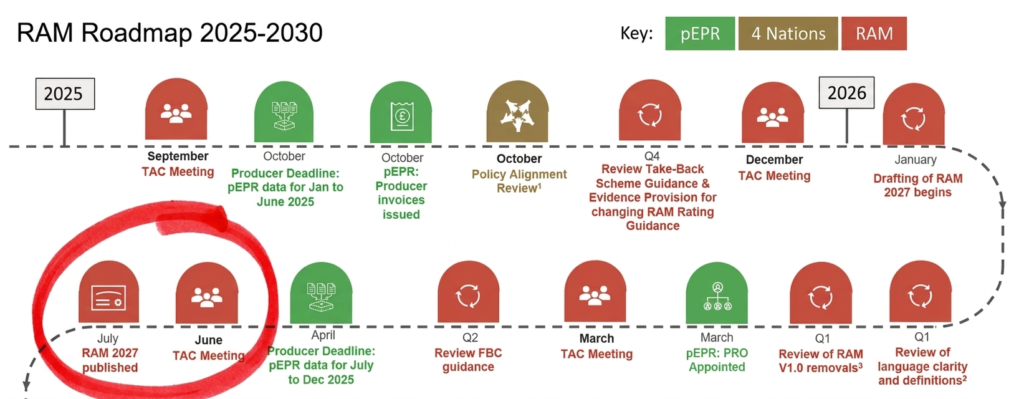
Your packaging recyclability assessment (RAM) that you spent the last year working on is about to be made redundant.
I’ve been part of PackUK’s Technical Advisory Committee for the last 9 months, and I’ve toiled over the old and new challenges that industry and policy makers are trying to balance. RAM 2027 is the next milestone.
Change is coming and it will impact your 2027 sales and pEPR fees.
If ever there was a story to show that compliance never stands still, then it would be the new UK packaging EPR regulations. With the roadmap recently published, we see the progressive nature of the policy, and increased reporting and cost liabilities placed on brands, importers, and manufacturers of packaging supplied in the UK.
This isn’t something that’s going to go away. This is going to get harder and require greater maintenance.
What’s changing?
The recyclability assessment (RAM) is getting its 2nd update. This means come 2027, a new set of rules will apply. These rules determine how much producers pay per tonne of packaging imported, introduced or which you are the brand holder. Each hand separable component will need to follow the new classification rules based on the ‘RAM 2027’. The guidelines are expected to be published this summer.
How much will EPR cost?
In 2027-28 (known as year 3 under the new Regulations) packaging classified as Red under the new RAM will cost 1.6 times more than what you’ve seen in the current Amber RAM fees. The following year it will be twice as high! So, what do I expect that to look like?
| Material | 2025 (what you are paying now without RAM) | 2027 Red RAM | 2028 Red RAM |
| Paper pEPR fee | £196/tonne | ~£340/tonne | ~£400/tonne |
| Plastic pEPR fee | £423/tonne | ~£730/tonne | ~ £850/tonne |
The other materials have equally alarming escalation of fees. For a typical mid size producer with £100k annual bill, for 2027 a 60% increase now means a ~£160k annual compliance costs. The following year? – the maths are easy but the result is alarming.
What are the next steps?
- Account for the change – get your data and budgets in line. Costs are driven by RAM, accuracy of data, and evidence.
- Make sure business leaders and operational teams understand why this is happening – packaging change doesn’t happen in one department, even if one department has to carry that cost.
- Set out your own roadmap – as a bottom line cost of sale, you might have already seen big brands warning of the impact of pEPR on consumer goods prices. Will your customer be ready or willing to accept further price increases? Planning, mitigation and communication will be essential.
- Get support where you need it – this is what I do. No 2 companies will be quite the same – product & packaging needs, costs, resources, ability to change. These variables need a bespoke and flexible approach to navigating the changes aheadin pEPR compliance. Bespoke upfront guidance give you access to expertise to measure, plan and mange changes you need, then own the transformation yourselves.
Whatever you do over the next 6 months, have a plan. Message and connect with me to learn more about how I help brands, manufacturers and importers with product, packaging and waste compliance.